
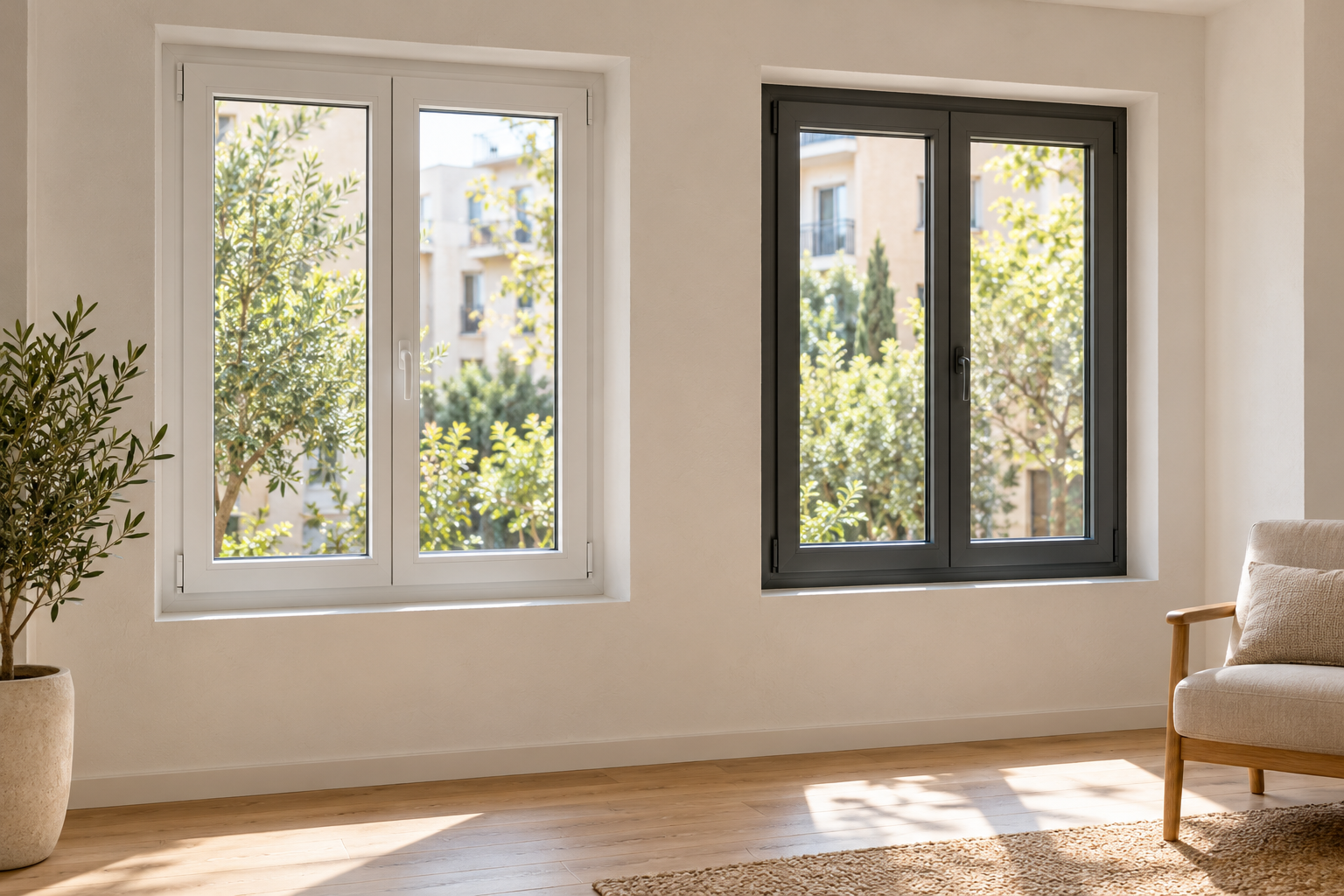
Replacing your windows can improve indoor temperatures, reduce outside noise and refresh the appearance of your home. When planning a renovation, one of the first decisions is often the frame material: PVC or aluminium. Both offer worthwhile options, but it helps to compare specific windows and understand what each one provides.
PVC stands out for its low thermal conductivity. Aluminium allows for strong frames and designs with slimmer sightlines, and its insulation can be improved by incorporating a thermal break.
The choice depends on the combination of frame, glazing, opening mechanism and installation. At Renov-Art, we assess these elements alongside the characteristics of your home to help you decide which solution best suits each room.
What PVC windows offer
PVC profiles have low thermal conductivity and usually incorporate internal chambers that contribute to insulation. This combination makes it possible to produce windows with good performance in reducing heat transfer between indoors and outdoors.
They are an attractive option when you want to improve comfort in bedrooms, living rooms and other frequently used spaces. The result also depends on the glazing, seals and how well the sashes fit.
PVC provides a good foundation for thermal insulation, which needs to be complemented by suitable glazing and careful installation.
Although white is a familiar finish, systems are available in other colours and textures. The available options depend on the manufacturer and the chosen range.
When assessing a PVC window, we also need to check its dimensions, the specified reinforcement and the weight of the glazing. These factors influence the sash design and operation, particularly in larger openings.
What aluminium windows offer
Aluminium makes it possible to manufacture strong frames and develop solutions with slim profiles, depending on the system and dimensions. It is worth considering when you want a distinctive appearance, a wide choice of finishes or a visual connection with the outdoors.
Its thermal performance changes significantly when a thermal break is incorporated. This introduces low-conductivity elements between the inner and outer sections of the profile to reduce heat transfer.
When comparing insulation, we need to distinguish thermally broken aluminium from conventional aluminium without a thermal break. Treating both as if they offered the same performance can lead to the wrong choice.
Aluminium windows also come in different ranges. The system depth, seal design and thermal break configuration influence the result. A window should be assessed by its declared performance as well as its frame material.
Comparing PVC and aluminium for a renovation
Before looking at the details, this comparison helps identify the factors that have the greatest influence on the decision.
| Criterion | PVC windows | Aluminium windows |
|---|---|---|
| Thermal insulation | Low material conductivity and a multi-chamber design | Assess thermally broken systems and their performance |
| Design | Different profiles, colours and textures depending on the range | A wide choice of finishes and slim profiles depending on the system |
| Dimensions | Reinforcement, dimensions and sash weight need to be checked | Profile sections, dimensions and permitted loads need to be checked |
| Sound insulation | Depends on the complete window | Depends on the complete window |
| Final choice | Compare the frame, glazing, opening mechanism and installation | Compare the frame, glazing, opening mechanism and installation |
Neither material guarantees the best result for every window opening in your home. A useful comparison starts with equivalent proposals in terms of size, opening mechanism and glazing.
Which figure should you check when comparing thermal insulation?
Thermal transmittance indicates how much heat passes through an element because of the temperature difference between its two sides. For a complete window, it is usually identified by the Uw value and expressed in W/m²K.
The lower this value, the better its thermal insulation, when comparing equivalent conditions. It should be distinguished from Ug, which refers to the glazing, and Uf, which refers to the frame.
Ask for the complete window value to avoid comparing the insulation of the glass alone with that of an entire window. Dimensions and the ratio of frame to glazed area also have an influence.
A thermally broken aluminium window can offer good performance, as can a well-configured PVC solution. To decide, we need to review the figures for each proposal.
Through our window replacement service in Valencia, we work with PVC and aluminium solutions, different opening mechanisms and glazing options to adapt the choice to each home.
Glazing should suit the climate and orientation
Glazing accounts for a large proportion of a window’s surface. Choosing it therefore deserves as much attention as selecting the frame material.
Double glazing incorporates a cavity between two panes of glass. Low-emissivity coatings help reduce heat transfer, while solar control solutions help limit the amount of solar energy entering the room.
Thermal insulation and solar control address related but different needs. A room exposed to afternoon sun may need a different combination from one facing a courtyard with little daylight.
We also need to consider light transmission to preserve the brightness the room requires. Shutters, awnings and other shading elements contribute to the performance of the overall system.
Triple glazing may suit certain projects, but its usefulness should be assessed alongside the climate, weight, frame and desired performance.
Reducing noise depends on the complete window
If your home faces a busy street, choosing between PVC and aluminium is only part of the decision. The glazing, the airtightness of the closure and the connections to the wall influence how much sound enters.
The glazing composition can be adapted to improve its acoustic performance. Options include panes of different thicknesses and laminated glass with specialist interlayers.
A window with good acoustic glazing needs suitable closure and installation to make the most of its performance. Uncontrolled air leakage can limit the result.
It is also worth checking the shutter box and other parts of the opening. Replacing only the frame and glazing can leave an important sound transmission path unresolved.
When comparing proposals, consider the sound insulation of the complete window and its suitability for the outside noise. The number of chambers or overall thickness alone is not enough to decide.
The opening mechanism should suit the space and its use
A convenient window should open without hitting furniture, taps or circulation areas. It is therefore worth considering the layout before choosing the sashes.
Casement windows open inwards or outwards, depending on the system. Tilt-and-turn windows combine a side-hinged opening with a top-tilting position. Sliding windows move the sashes sideways, making them useful where a hinged opening would be inconvenient.
The opening mechanism influences convenience, ventilation and airtightness. Traditional sliding windows and higher-performance sliding systems can behave differently, so we need to compare specific models.
In bedrooms, an opening that makes ventilation and cleaning easier may be useful. In a living room leading onto a terrace, circulation and the clear opening size become more important. The solution should meet these everyday needs.
Installation and finishing are part of the result
The connection between the window and the façade must address fixing, insulation and sealing. A high-performance window needs an installation that maintains the continuity of the building envelope.
Before replacement, we need to inspect the opening, the condition of the supporting structure and whether existing elements should be retained or removed. Keeping an old frame can alter the available glazed area and the connections around the new window.
The quotation should specify how the window will be installed and how the internal and external finishes will be completed. It is also worth defining what will happen to shutters, insect screens, sills and affected wall finishes.
When window replacement forms part of a wider renovation, planning it from the outset makes it easier to coordinate measurements, manufacturing and finishing work.
In our full home renovations in Valencia, we coordinate joinery, building work, painting and other tasks so that the different project stages fit together.
How to compare prices and maintenance
The price depends on the dimensions, profile range, glazing, hardware, finish and installation complexity. Differences between quotations may reflect performance or the work included, as well as the material.
To compare them, check that both proposals cover the same dimensions, opening mechanism and glazing composition. Then review the removal of the old windows, finishing work and accessories.
A detailed quotation helps you understand what you are choosing and where it makes sense to adjust your spending. Comparing only the final price overlooks decisions that affect everyday use.
Both PVC and aluminium allow for straightforward routine maintenance. Follow the manufacturer’s instructions for cleaning frames and glass, caring for seals and maintaining hardware. Drainage openings also need to remain clear to work properly.
Which should you choose for your home?
PVC may be particularly suitable if thermal insulation is a priority and you find a configuration that meets your requirements for dimensions and appearance. Thermally broken aluminium offers an attractive alternative when profile design, finishes or the characteristics of the opening carry particular weight.
In both cases, it is worth reviewing the glazing and opening mechanism room by room. A bedroom exposed to traffic and a west-facing living room may need different solutions within the same renovation.
The best choice is a window specified for your home, with verifiable performance and a planned installation. At Renov-Art, we can assess the condition of your windows and your priorities to propose a solution that fits the renovation as a whole.